
Stephanion Observatory | Telescopes & Instruments
The 30-inch Cassegrain Reflector
THE RESEARCH
The Telescope That Shaped Stephanion’s Scientific Legacy
The successful operation of Stephanion Observatory’s first scientific facilities — the 38 cm telescope of Hamburg Observatory, the 40 cm telescope of Utrecht Observatory, and the CNES satellite tracking station — demonstrated, by the late 1960s, the exceptional potential of the site for astronomical research.
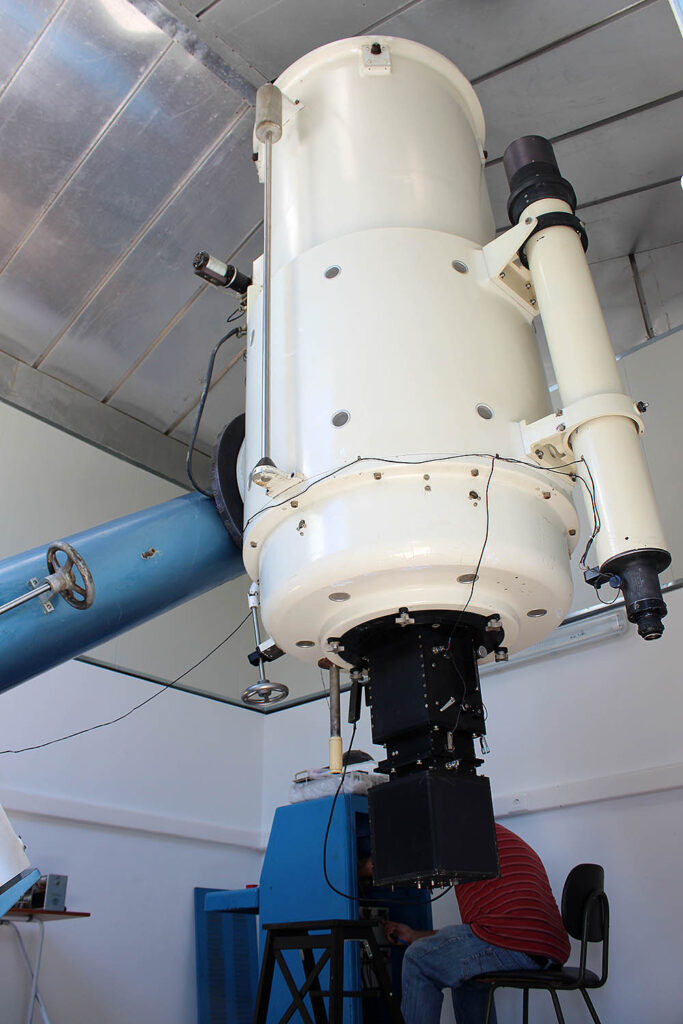
Photoelectric observations carried out at Stephanion between 1967 and 1970 confirmed that the local observing conditions were particularly well suited to systematic stellar research. Building on these results, Professor Lysimachos Mavridis, head of the Laboratory of Geodetic Astronomy at the Polytechnic School of the University of Thessaloniki, proposed the installation of a substantially larger instrument: a 30-inch (76 cm) Cassegrain reflecting telescope, manufactured by the American company Astro Mechanics Inc.
The new telescope was installed in the summer of 1971, in the building that had previously housed Hamburg Observatory’s 38 cm telescope. To accommodate the considerably larger instrument, the existing roll-off roof had to be raised and specially adapted to meet the requirements of the new telescope.
With its first test observations, a new era began for Stephanion Observatory. The 30-inch Cassegrain became the Observatory’s principal scientific instrument and, over the following decades, was used extensively for photoelectric observations of variable and active stars, establishing a long tradition of stellar research that remains a central part of Stephanion Observatory’s scientific legacy today.
EXPLORE
The 30-inch Cassegrain reflector
Early photoelectric measurements made with the 38 cm telescope from the Hamburg Observatory and the 40 cm telescope from the Utrecht Observatory demonstrated that Stephanion offered excellent conditions for modern astronomical research. In 1971, following these promising results, the Aristotle University of Thessaloniki chose the site for the installation of a new 30-inch Cassegrain reflector.
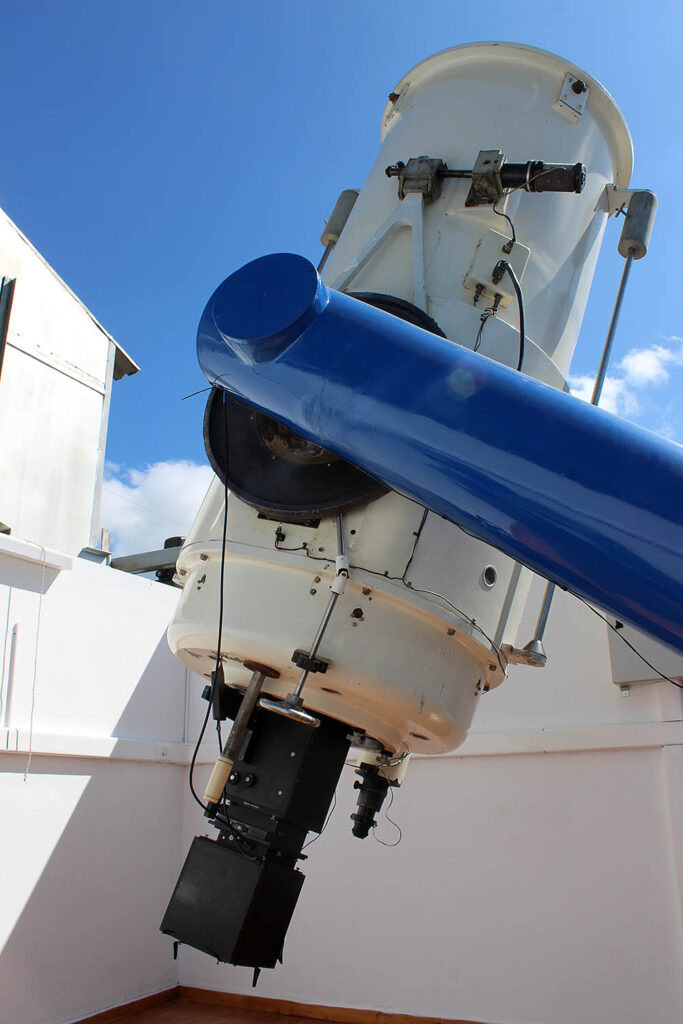
Built by the U.S. company Astro Mechanics Inc. of Austin, Texas, and featuring an asymmetric mount, the telescope (focal ratio f/3 for the primary hyperbolic mirror and f/13.5 for the Cassegrain focus) was complemented by a suite of specialized auxiliary instruments:
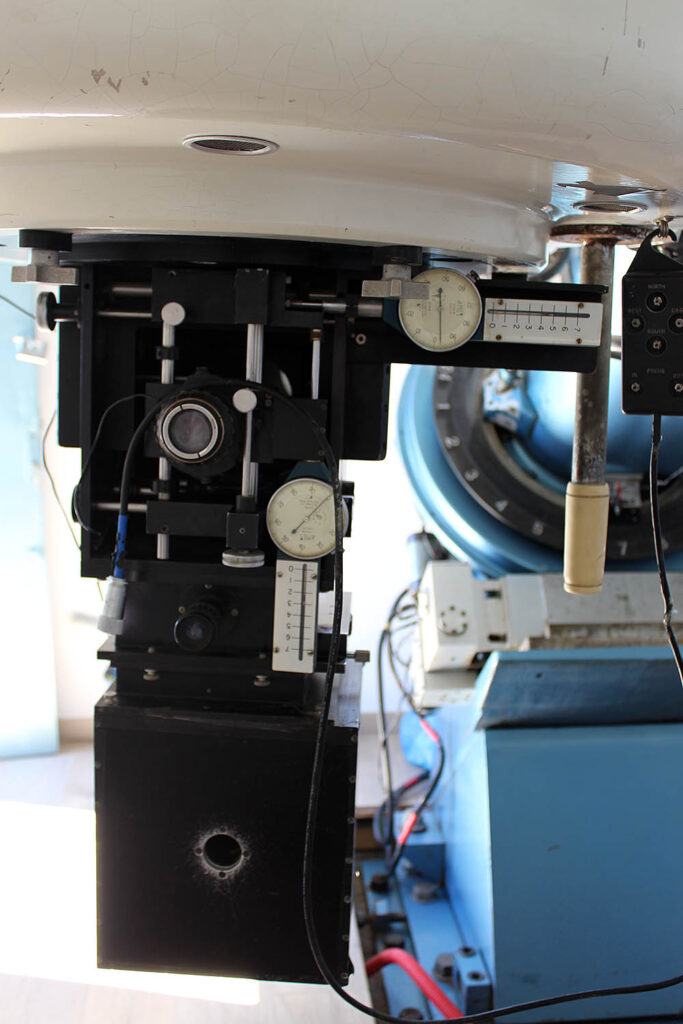
– A Johnson dual-channel photoelectric photometer with an offset guider unit, including one RCA 1P21 and one RCA 7102 refrigerated photomultiplier, manufactured by Astro Mechanics Inc. Cooled with dry ice, it enabled photoelectric measurements in the U, B, V, R, and I bands of the international UBV photometric system.
– A Meinel plane-grating spectrograph featuring a flat-field folded Schmidt camera (f/2), also constructed by Astro Mechanics Inc.
When it was installed at Stephanion Observatory in June 1971, the 30-inch (76 cm) Cassegrain reflector was the largest astronomical telescope in Greece and the Balkans. As one of the country’s first modern research telescopes, it marked the beginning of a new era for observational astrophysics in Greece and remained the country’s largest telescope until 1975.

FAQs
What is Photoelectric Photometry?
Photoelectric photometry precisely measures a star’s brightness and color. Before the advent of digital CCD cameras, telescopes focused starlight through filters—such as U, B, and V in the Johnson system—onto a highly sensitive detector called a photomultiplier tube. Through the photoelectric effect, incoming photons were converted into an electrical signal directly proportional to the star’s brightness. This technique enabled astronomers to detect subtle variations, determine stellar temperatures, and study variable stars with exceptional accuracy, making it the gold standard of stellar photometry for many decades.
auxiliary instruments
The Johnson dual-channel photoelectric photometer
A Johnson dual-channel photoelectric photometer is a precision instrument used in astronomy to measure a star’s brightness in two different colors at the same time. Designed by Harold Johnson, the creator of the UBV photometric system, it played a key role in establishing modern stellar photometry.
The photometer splits the incoming starlight into two beams using a special optical element. Each beam passes through a different UBV filter (such as B and V) and is recorded by its own photomultiplier tube (PMT). By measuring both colors simultaneously, the instrument eliminates errors caused by atmospheric variations and provides highly accurate color indices.
This type of photometer was essential for studies of variable stars, flare activity, and standard star calibration, offering excellent time resolution and precision before the advent of CCD detectors.
The Johnson dual-channel photoelectric photometer of the Stephanion Observatory was manufactured by Astro Mechanics Inc. and is equipped with an offset guider unit, as well as one RCA 1P21 and one RCA 7102 refrigerated photomultiplier. Cooled with dry ice, it enables photoelectric measurements in the U, B, V, R, and I bands of the international UBV photometric system.
RESEARCH ACTIVITIES
Photoelectric Observations of Variable Stars
Photoelectric photometry has played a central role in the study of variable stars. By measuring a star’s light with a photomultiplier tube, astronomers can detect extremely small changes in brightness—often down to thousandths of a magnitude. These observations are made through standard filters (such as U, B, and V in the Johnson system), allowing precise tracking of both luminosity and color variations.
The resulting light curves reveal essential information about each star’s behavior: pulsations, rotational modulation from starspots, eclipses in binary systems, or sudden brightenings in flare stars. Long-term series of photoelectric measurements have provided key insights into stellar activity, structure, and evolution.
At the Stephanion Observatory, three main categories of variable stars were systematically investigated through long-term photoelectric monitoring:
flare stars of the solar neighborhood (e.g., EV Lac, BY Dra, AD Leo), RS CVn stars such as II Peg, and galactic Cepheids.
Over the years, more than 170 original scientific papers based on these observational programs were published. This extensive output established the Stephanion Observatory as one of the leading astrophysical centres worldwide in the study of stellar activity and variability.
FAQs
What Are Variable Stars?
Variable stars are stars whose brightness changes over time as observed from Earth. These variations can be subtle or dramatic and occur for different physical reasons. Some stars are intrinsic variables, meaning their brightness changes because of processes inside the star—such as pulsation, magnetic activity, or sudden flares. Others are extrinsic variables, where the change in brightness is caused by outside factors, like one star passing in front of another in an eclipsing binary system.
Variable stars are powerful tools in astronomy. Their light changes help us measure stellar temperatures, sizes, magnetic activity, and evolution. Certain variable stars, like Cepheids, even serve as important distance indicators for mapping the scale of our galaxy and beyond.
In essence, variable stars reveal how stars behave, evolve, and interact—offering key insights into the workings of the universe.
RESEARCH ACTIVITIES
Is There a Five-Year Activity Cycle on EV Lac?
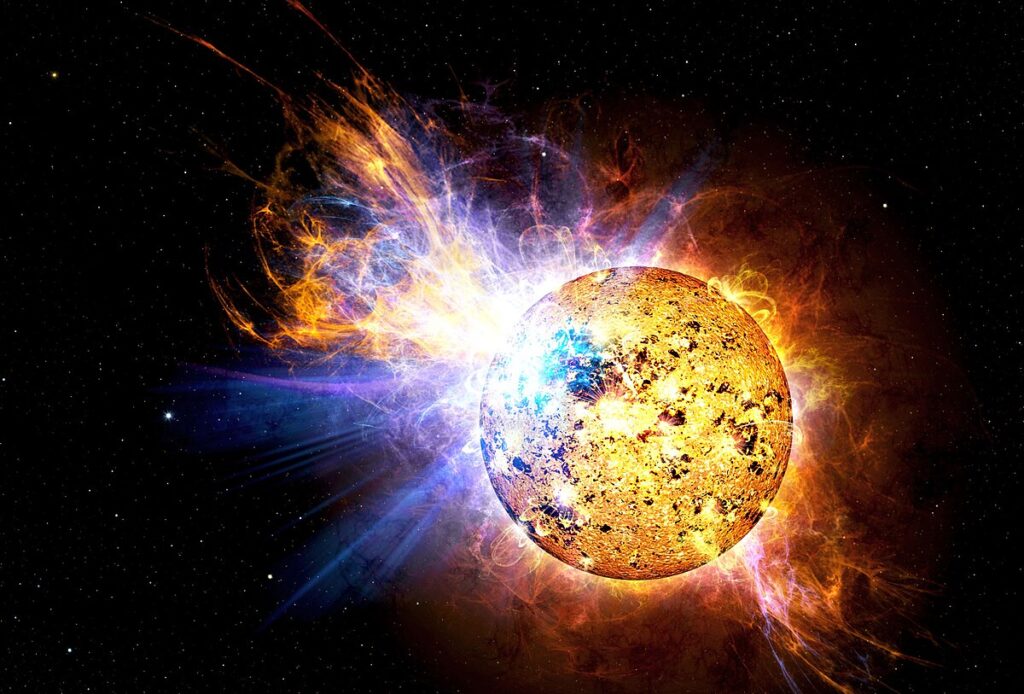
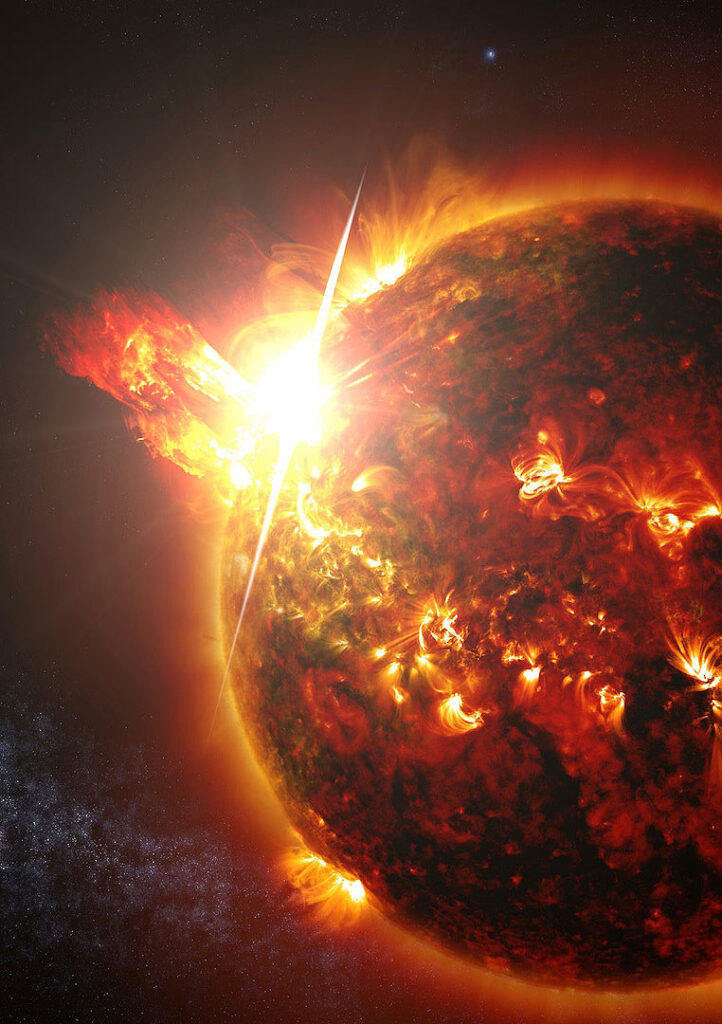
EV Lacertae (EV Lac) is one of the most active flare stars in the solar neighborhood. Since the 1960s it has been monitored extensively for changes in brightness, flare frequency, and magnetic behavior. In 1986, Stavros Avgoloupis and Lyssimachos Mavridis published an influential study of long-term photometric data that suggested that EV Lac might exhibit a repeating five-year activity cycle—a pattern somewhat analogous to the Sun’s 11-year sunspot cycle.
The claim was based on roughly a decade of ground-based patrol observations (long-term photometry) with the 30-inch Cassegrain reflector of the Stephanion Observatory. The Greek astronomers reported that EV Lac’s quiescent brightness and flare activity appeared to rise and fall in a pattern repeating every ≈5 years. This made EV Lac one of the first flare stars for which a long-term magnetic cycle was proposed.
Over the past two decades, EV Lac has been studied with far more sensitive tools (TESS + Swift + NICER + ground telescopes), but while they find variability on multiple timescales (rotation, months–years) and clear long-term changes in activity, they do not yet show a stable, repeatable 5-yr cycle at the confidence level one would require to claim a robust stellar activity cycle. To definitively answer the question, researchers need long-term, homogeneous monitoring that spans decades—combining precise space photometry with ground-based observations and magnetic field measurements. EV Lac remains a prime target for such studies, both because of its intense magnetic activity and because cycles in fully or nearly fully convective stars are key to understanding the nature of stellar dynamos.
© Casey Reed/NASA
© NASA’s Goddard Space Flight Center
RESEARCH ACTIVITIES
A Breakthrough Observation
In 1989, Stavros Avgoloupis and Ioannis Seiradakis of the Aristotle University of Thessaloniki achieved a milestone in stellar activity research with the first simultaneous detection of a large flare in both X-ray and optical wavelengths on the RS CVn-type star II Pegasi (II Peg).
The flare was recorded at the same time by the Japanese X-ray satellite GINGA, capturing high-energy emission from the star’s superheated corona, and the 30-inch Cassegrain reflector of the Stephanion Observatory, which detected a pronounced increase in brightness in the U-band (ultraviolet–blue optical light).
This was a surprising discovery. Until then, astronomers believed that RS CVn stars—known for intense magnetic activity—rarely produced broadband optical flares. The II Peg flare demonstrated that extremely energetic events on these stars can in fact generate detectable “white-light” optical emission, similar to the most powerful solar flares.
The 1989 detection was important for several reasons: The flare showed that magnetic eruptions on RS CVn stars affect multiple layers of the star’s atmosphere—from the deep photosphere (optical) to the hot corona (X-ray). Using both datasets, researchers estimated the flare’s total energy output, revealing an enormously powerful event comparable to (or exceeding) some of the most energetic stellar flares known at the time. The event reshaped the understanding of RS CVn star systems in that they are not merely X-ray bright but can produce rare but significant optical continuum flares, which are structurally similar to large solar flares, but scaled up by many orders of magnitude.
The discovery encouraged a new generation of multiwavelength monitoring campaigns for active stars. Today, II Peg is recognized as one of the most active RS CVn systems, and the 1989 flare remains a cornerstone event in the study of stellar magnetic activity.