Welcome
Exploring
the Universe at
Stephanion Observatory
since 1966
Stephanion Observatory will be open on Sunday 04/10/2026 from 11:00 to 18:00
OUR MISSION
An Observatory with a Remarkable Scientific Legacy
Founded in 1966, Stephanion Observatory became one of Greece’s earliest centres of international astronomical and space research. From French satellite tracking and European observing programmes to decades of stellar photometry by the Aristotle University of Thessaloniki, resulting in more than 170 scientific publications, and today’s exoplanet research and citizen science, the Observatory has connected this small mountain site with the wider scientific world for sixty years.
The Observatory stands on Dragatoura Hill in the northeastern Peloponnese, just west of the village of Stephani, on the present-day border between the regional units of Corinthia and Argolis, at an altitude of approximately 800 metres.
Today, the Observatory is a public facility owned by the Municipality of Corinth. Its programme of public observations, educational activities and astronomy outreach is supported by the Astronomical Union of Corinth “ASTERION”, while a Memorandum of Understanding between the Municipality of Corinth, the National Observatory of Athens and the University of Patras provides a framework for scientific cooperation, citizen science, public engagement and the exchange of scientific expertise.
Combining public outreach, scientific research and the interpretation of its scientific heritage, Stephanion Observatory represents a unique model in Greece: a public observatory, active research facility and exhibition space within one historic scientific site.
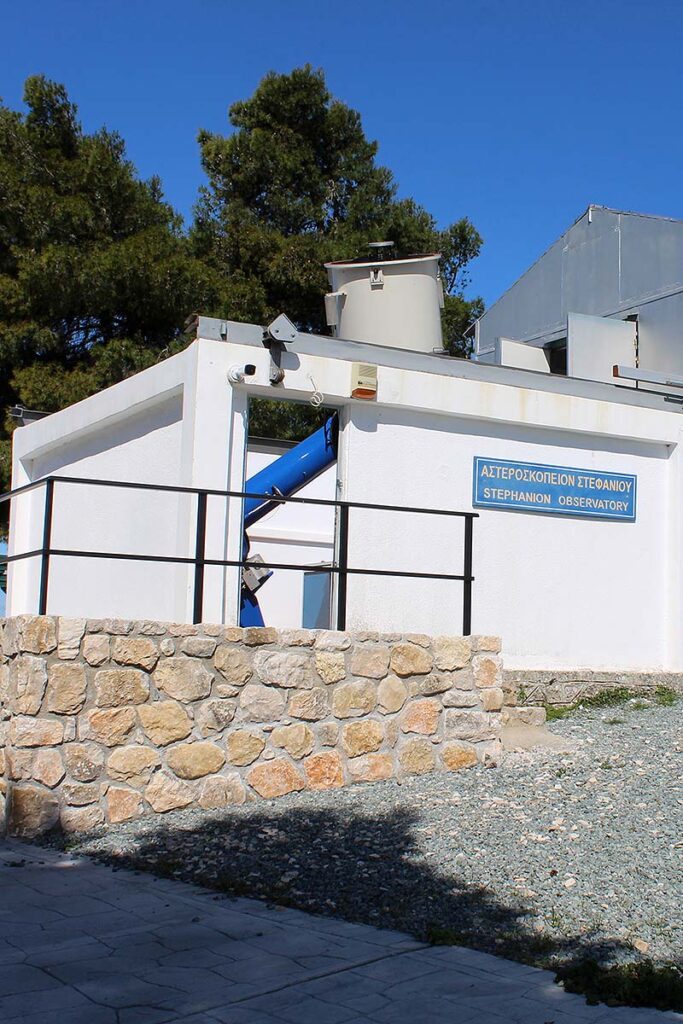
Explore the Observatory
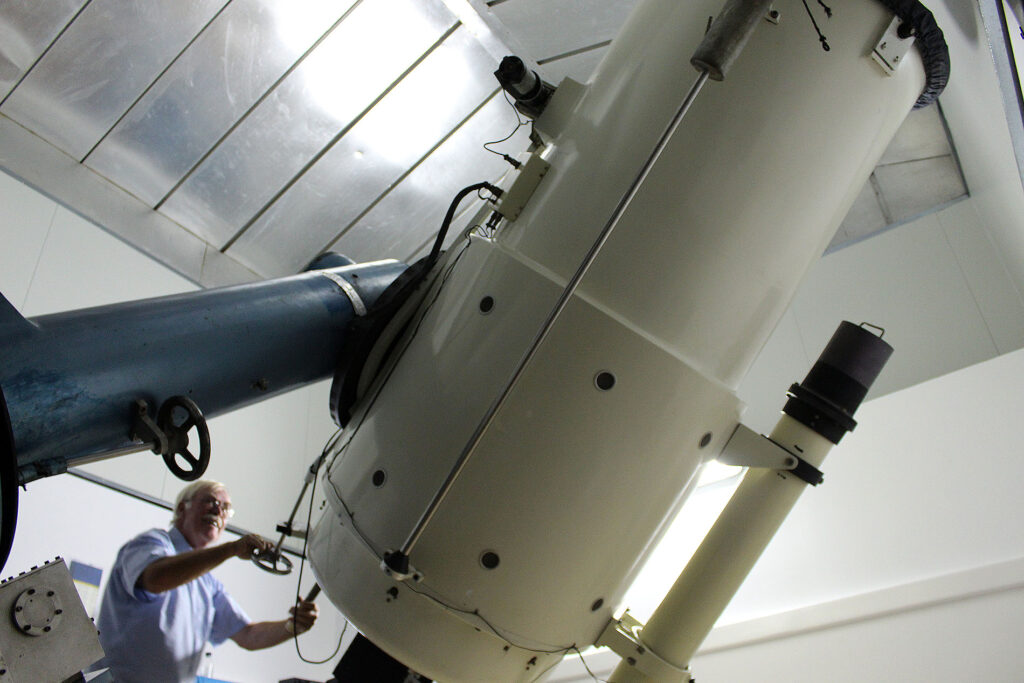
Telescopes & Instruments
Discover the telescopes that turned Stephanion’s gaze towards the Universe: from historic research instruments and the iconic 30-inch Cassegrain to today’s telescopes for scientific research, solar observation and stargazing.
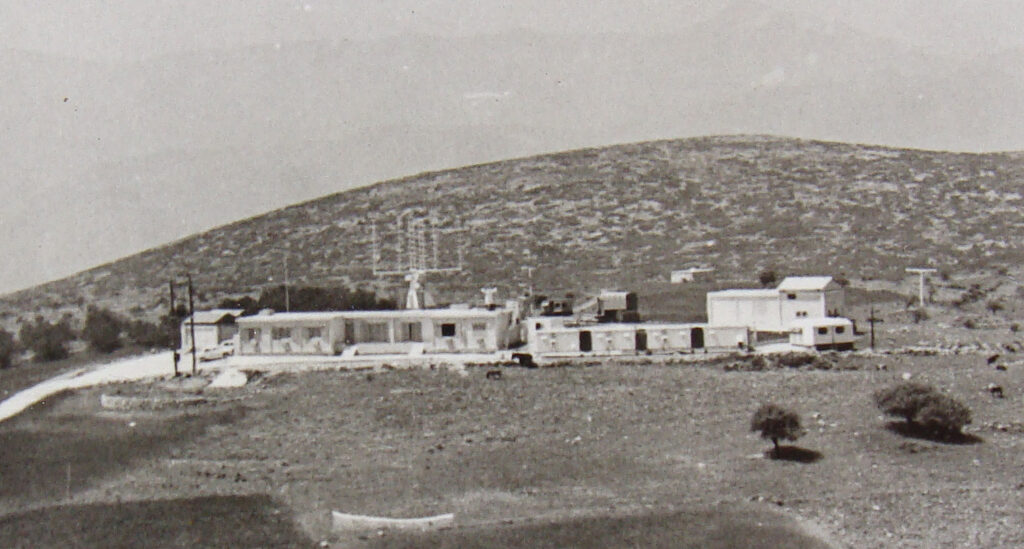
The Observatory’s History
Follow the story of Stephanion Observatory from 1966 and the dawn of the Space Age, the French satellite-tracking campaign and the first European observing programmes, to the decades of astronomical research that followed.
Scientific Research & Legacy
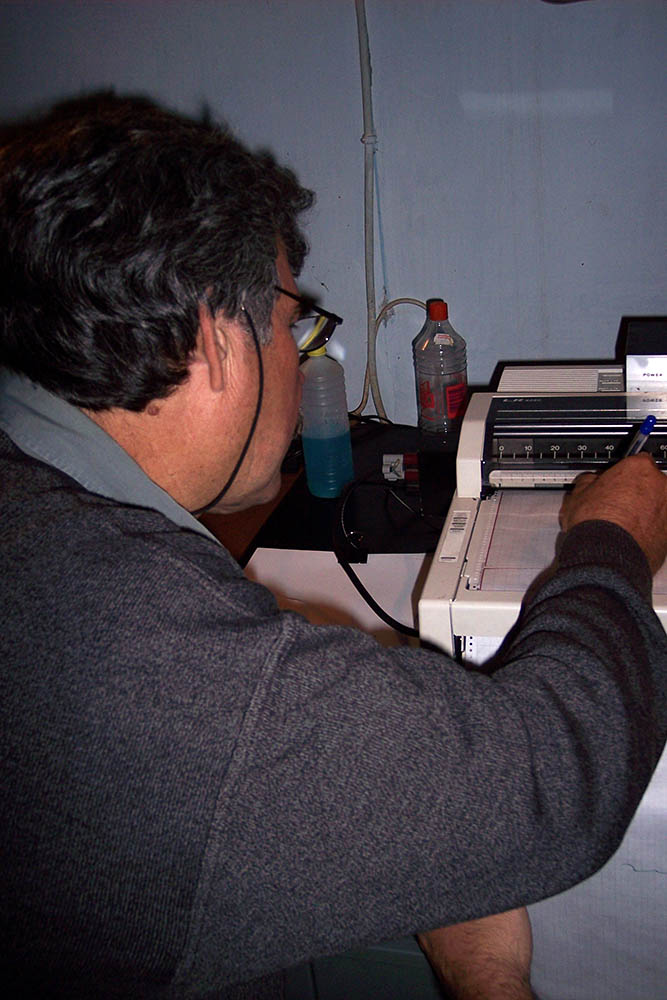
Discover nearly four decades of astronomical research at Stephanion: variable stars and stellar flares, international observing collaborations, and more than 170 scientific publications.
SUMMER 2026
Solar Sundays at the Observatory!
Have you ever seen the Sun’s eruptions and giant prominences rising thousands of kilometres above its surface?
This summer, every Sunday, we invite you to Stephanion Observatory for a unique experience of solar observing and an introduction to astronomy. Through our specialized Hydrogen-alpha (Hα) telescope, you will see the Sun as few people ever have the opportunity to see it: with flares, prominences and remarkable details of its chromosphere.
Come with your family or friends and join us in discovering the science, beauty and mysteries of our nearest star. Your guide will be Giannis Kostidis, an intern from the Department of Physics at the University of Patras, specializing in Astronomy.


RESEARCH
Hunting for Exoplanets
Today, Stephanion Observatory is an active site of scientific research, hosting observations conducted by the University of Patras as part of the international ExoClock programme. Using the Observatory’s robotic telescope, observations can be carried out both on site and remotely, enabling the systematic collection of valuable scientific data.
ExoClock aims to precisely monitor the transits of exoplanets across their host stars in order to improve predictions of their transit times. These data are essential for the successful implementation of the European Space Agency’s (ESA) Ariel space mission, which will study the atmospheres of around 1,000 exoplanets, searching for clues about their composition, formation and evolution.
Through this collaboration, Stephanion Observatory actively participates in an international research network, contributing to the preparation of one of Europe’s most important space missions in the field of exoplanet science.

DISCOVER
The Planet Trail
Imagine being able to walk through space and meet, one by one, the planets of our Solar System — along with moons, comets, asteroids, meteoroids and dwarf planets.
On the Planet Trail at Stephanion Observatory, the entire Solar System has been scaled down to fit along a 590-metre trail! This means that every metre you walk represents approximately 10 million kilometres in space!
Get ready for a unique journey of discovery, where every step brings you closer to the mysteries of the Universe!
Past Events
From stargazing nights and public lectures to educational activities, explore some of our recent events at Stephanion Observatory
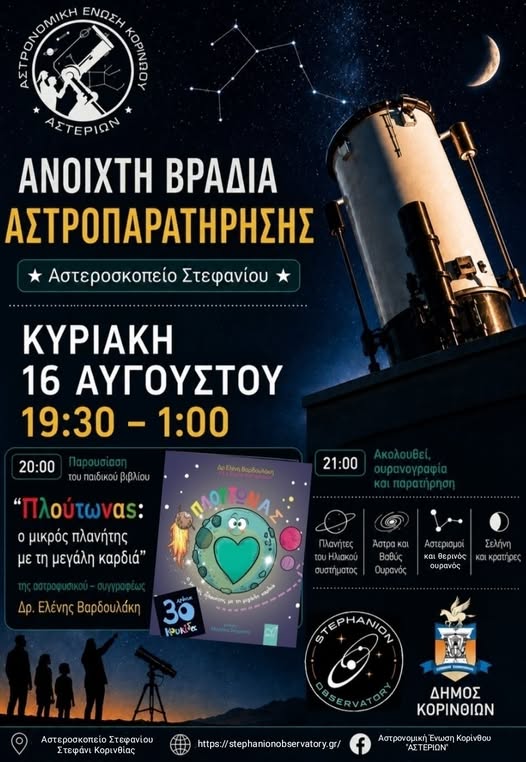
Stargazing Night & book presentation
With astrophysicist and author Dr Eleni Vardoulaki, featuring the presentation of the children’s book “Pluto: The Little Planet with the Big Heart”. A guided tour of the night sky and stargazing through the Observatory’s telescopes.
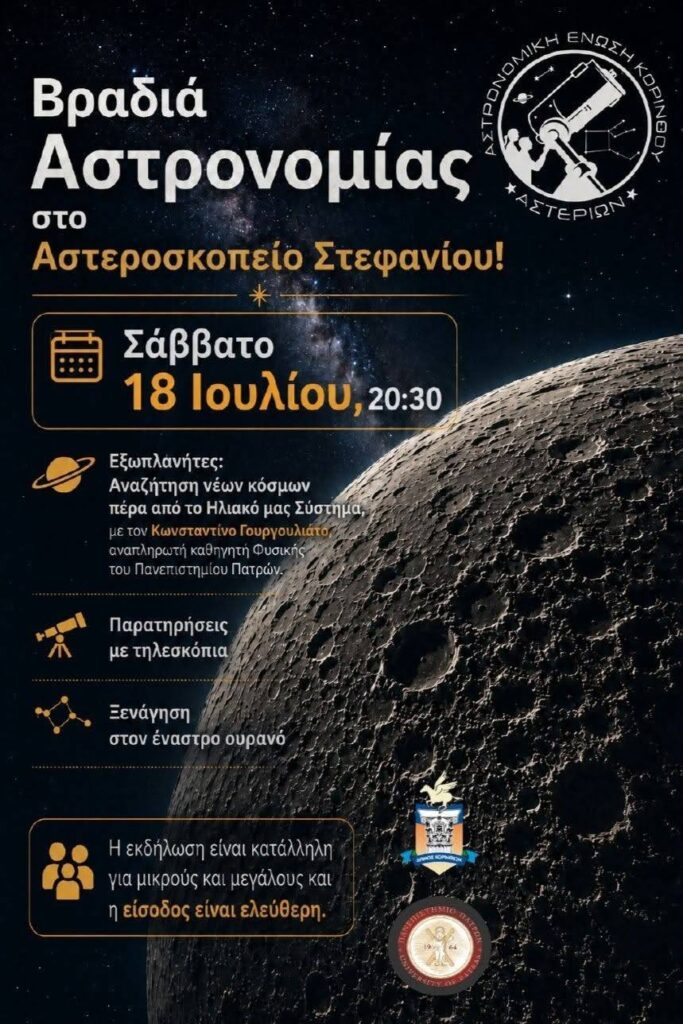
Stargazing Night & public lecture
An evening under the stars featuring a public lecture by Prof. Konstantinos Gourgouliatos, University of Patras, on exoplanet research at Stephanion Observatory, followed by stargazing through the Observatory’s telescopes.

Solar & Stargazing Night
An afternoon and evening of solar observation and stargazing through the Observatory’s telescopes, together with a guided tour of our astrophotography exhibition.
Observing the Sky
Anyone can be an observer, and we are here to help. Let us take you on a journey of discovery to find out how we watch and listen to space, what we know about the galaxies beyond, and what is yet to be discovered!
You may look through the public telescopes of the observatory or the telescopes of the Astronomical Union of Corinth “ASTERION” or use our astronomical information to observe from your own backyard.
Check out the monthly Sky Report to see what you can observe in Stefani.
Visit
Take the road to the Stars!
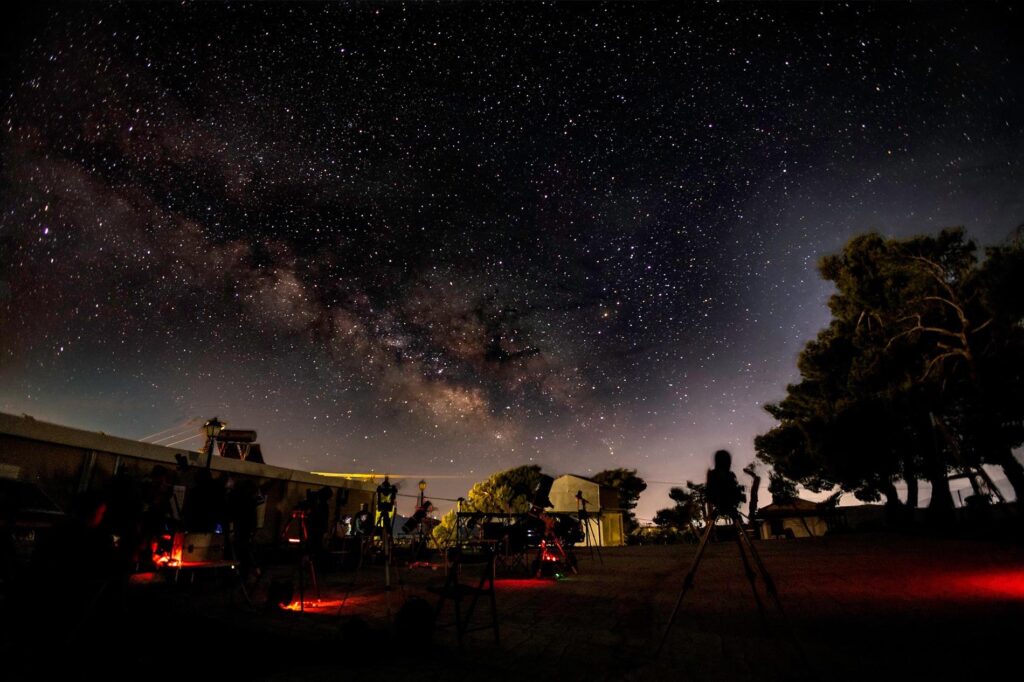
Located on the top of Dragatoura Hill at an altitude of 800 m. just outside the village of Stephani, the Stephanion Observatory is easily accessible by car from Athens and Corinth as well as from the Argolis.
Contact US
Address
20008 Stephani Corinthia
Send us an e-mail
Check-out ways to contact us


