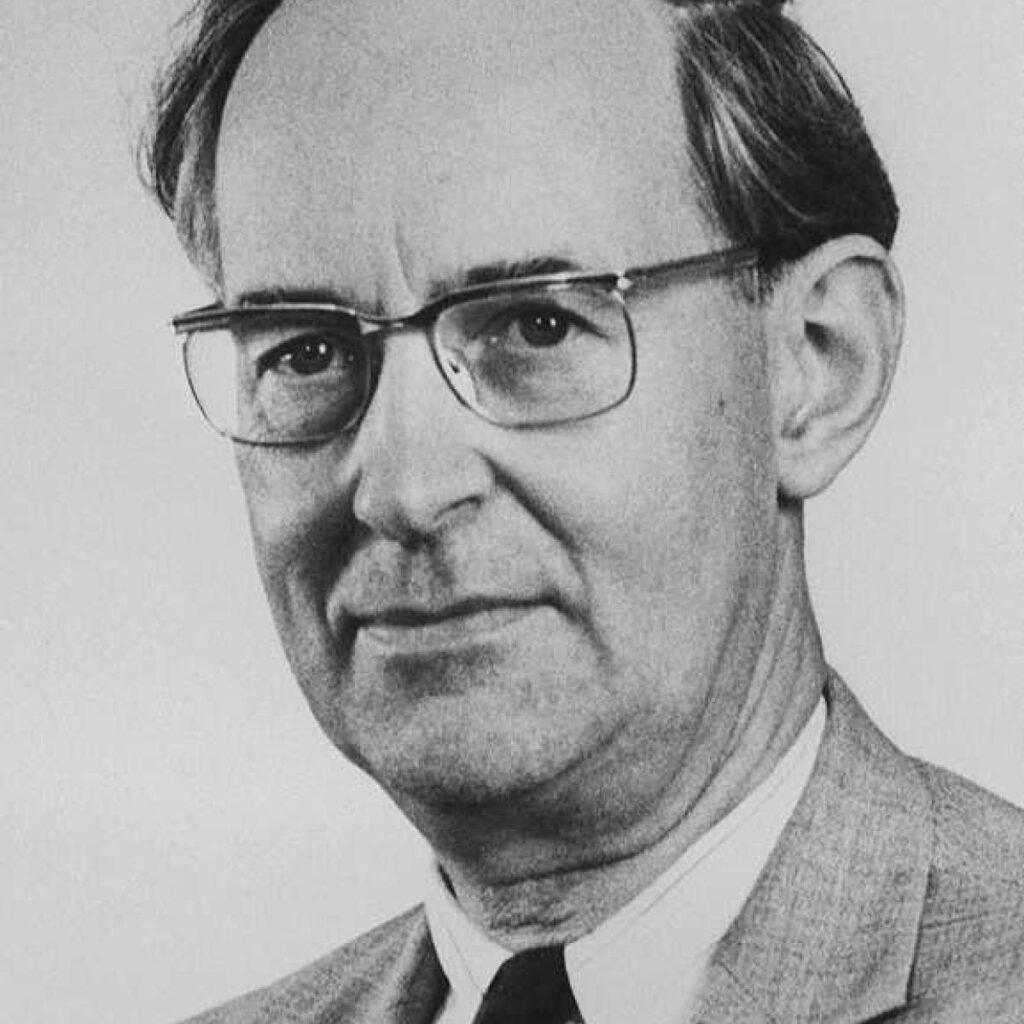
Stephanion Observatory | The Visionaries
Adriaan Blaauw (1914-2010)
Dutch Astronomer, ESO Pioneer and Key Figure in the Founding of Stephanion Observatory
The Architect of Modern European Astronomy
Adriaan Blaauw was one of the most influential European astronomers of the twentieth century and a leading figure in the development of international astronomical cooperation after the Second World War.
In the spring of 1964, he organized the Dutch scientific expedition that visited Stephani to assess its potential as an astronomical observing site, returning again in 1967 as the new station was taking shape. His involvement formed part of a wider Dutch effort to establish access to southern skies before the European Southern Observatory in Chile became fully operational — an effort that led to the creation at Stephanion of the Netherlands European Southern Observing Station (N.E.S.O.S.).
Born in Amsterdam, Blaauw studied astronomy at Leiden University under the renowned Jan Oort. His pioneering research on stellar associations and the structure of the Milky Way made him one of the world’s foremost experts on star formation and Galactic astronomy.
Following research appointments in the Netherlands and at the Yerkes Observatory near Chicago, where he also received an assοciate professor appointment in 1953, Blaauw became Director of the Kapteyn Astronomical Institute in Groningen in 1957. During this period he emerged as one of the principal advocates of European scientific collaboration in astronomy, believing that ambitious astronomical projects could only be achieved through cooperation between nations.
His vision played a decisive role in the creation of the European Southern Observatory (ESO), the organization established to provide European astronomers with access to the southern skies. Blaauw was among the architects of the project from its earliest stages serving as a ESO’s Science Director in 1968 and later as ESO’s Director General from 1970 to 1975. Under his leadership, ESO consolidated its position as one of the world’s leading astronomical institutions.
In 1964, Blaauw led the Dutch astronomical mission that visited Greece in search of a suitable site for a new observing station. Working closely with Lysimachos N. Mavridis and the National Astronomical Committee of Greece, he helped identify the mountainous regions of Corinthia and Argolis as promising locations for astronomical observations. The visit ultimately led to the selection of Stephani and marked the beginning of the international collaboration that would give birth to Stephanion Observatory.
Blaauw remained a strong supporter of the project in the years that followed. His advocacy was instrumental in securing a NATO Science Committee grant for the Greek-German research programme of Heinz Neckel and Lysimachos Mavridis, which enabled the transfer of the Hamburg Observatory reflector to Greece and laid the foundations for the establishment of Stephanion Observatory. Through his scientific influence, international connections and unwavering support, Blaauw helped transform an ambitious local initiative into a project of European significance.
Beyond his contributions to Stephanion, Blaauw served as President of the International Astronomical Union (1976–1979), chaired the Scientific Programs Selection Committee that defined the priorities of the European Space Agency’s satellite, Hipparcos, and received numerous international honours, including the prestigious Bruce Medal in 1989. Today he is remembered not only as a distinguished astronomer, but also as one of the architects of modern European astronomy.
Throughout his career, Blaauw championed the idea that astronomy transcends national borders. Stephanion Observatory remains a small but enduring example of that vision, born from the collaboration of astronomers from across Europe who came together under the Greek sky.