
Explore
Telescopes and Instruments
THE INSTRUMENTS OF DISCOVERY
Sixty Years of Astronomical Observations
Since its establishment in 1966, Stephanion Observatory has hosted important astronomical instruments, telescopes and a satellite-tracking system, playing a significant role in the development of astronomical and space research in Greece.
Among them were the 38 cm reflector of the Hamburg Observatory and the 40 cm Van Straaten reflector of the Utrecht Observatory, as well as the scientific satellite-tracking station of the French National Centre for Space Studies (CNES), equipped with laser-ranging systems and Doppler receivers. Their presence established Stephanion as one of the early hubs of international scientific and space collaboration in Southeastern Europe.
Since 1971, the heart of the Observatory has been — and remains to this day — the 30-inch (76 cm) Cassegrain reflector of the Aristotle University of Thessaloniki, one of Greece’s first modern research telescopes. For decades, it was used for systematic photoelectric stellar photometry, establishing Stephanion Observatory as an important centre for the study of stellar activity and variability, with particular emphasis on flare stars and RS CVn systems. This research resulted in more than 170 scientific publications in international journals.
With the transformation of the Observatory into a Public Observatory in 2014, a new chapter in its history began. The site was upgraded and equipped with modern telescopes, astronomical instruments and equipment supporting scientific research, Citizen Science projects, as well as astronomy education and public outreach.
TELESCOPES
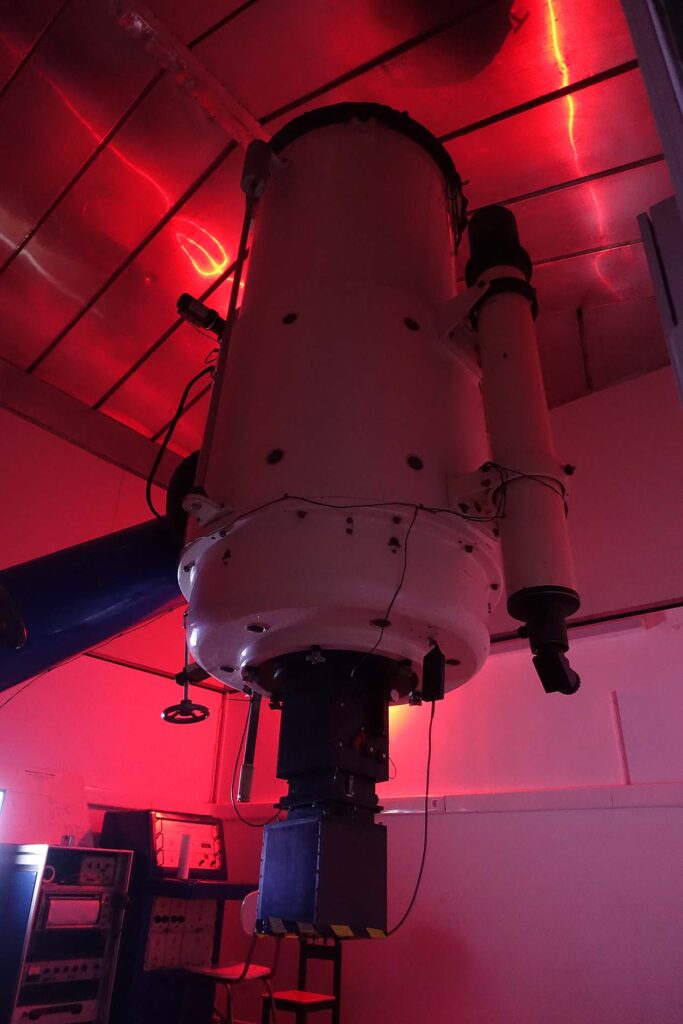
The 30-inch Cassegrain reflector
In 1971, the Aristotle University of Thessaloniki chose the Stephanion Observatory for the installation of a new 30-inch Cassegrain reflector.
Built by the U.S. company Astro Mechanics Inc. of Austin, Texas, and featuring an asymmetric mount, the telescope (focal ratio f/3 for the primary hyperbolic mirror and f/13.5 for the Cassegrain focus) was complemented by a suite of specialized auxiliary instruments:
– A Johnson dual-channel photoelectric photometer with an offset guider unit, including one RCA 1P21 and one RCA 7102 refrigerated photomultiplier, manufactured by Astro Mechanics Inc. Cooled with dry ice, it enabled photoelectric measurements in the U, B, V, R, and I bands of the international UBV photometric system.
– A Meinel plane-grating spectrograph featuring a flat-field folded Schmidt camera (f/2), also constructed by Astro Mechanics Inc.
The telescope distinguished itself in the field of photoelectric observations and, over a period of 38 years, contributed to the publication of more than 170 original scientific papers in the international scientific literature.
TeleSCOPES
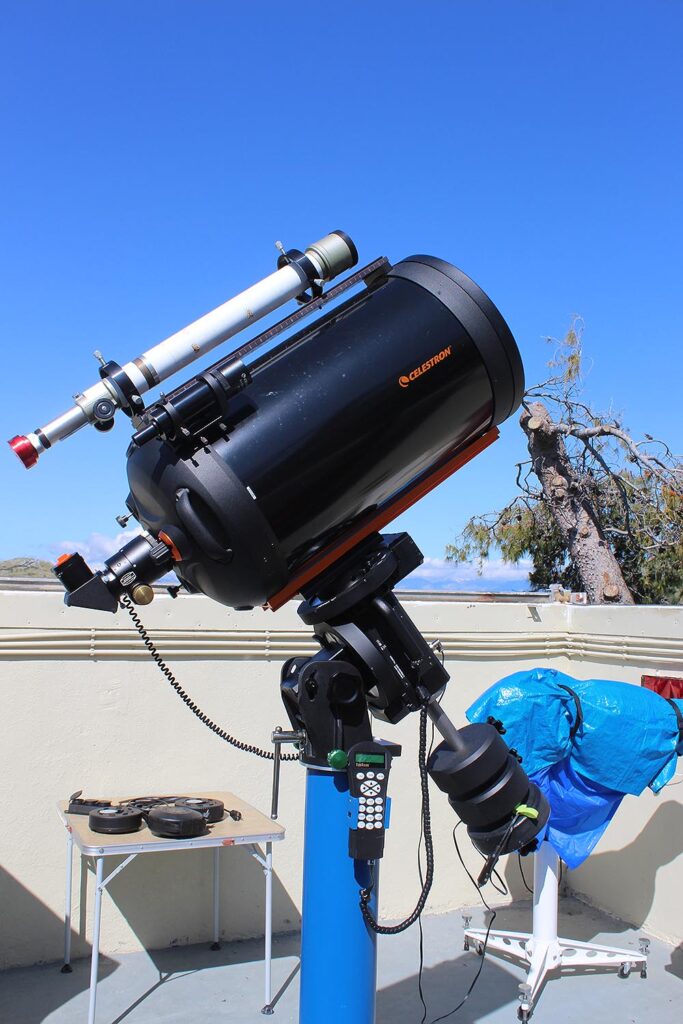
Celestron 14″ Schmidt-Cassegrain Telescope
In 2018, the Municipality of Corinth, on the initiative of Mayor Alexandros Pnevmatikos, purchased the Celestron 14″ Schmidt-Cassegrain Telescope to support the observatory’s mission, including public outreach, citizen science projects and educational programs.
The Telescope—commonly known as the C14—is one of the most respected large-aperture telescopes used by advanced amateurs, university observatories, and research groups worldwide.
The C14 uses a compact folded-optics system that delivers a long 3910 mm focal length (f/11) in a relatively short and portable tube. The telescope reveals faint galaxies, nebulae, and star clusters with exceptional detail. Its theoretical resolution (~0.33 arcseconds) allows fine planetary features and tight double stars to be observed when atmospheric conditions permit.
The C14 system of the Stephanion Observatory includes specialized high-quality accessories that significantly expand its capabilities:
– SkyWatcher EQ8 GoTo Mount, a heavy-duty equatorial mount with excellent tracking precision.
–Celestron HyperStar Lens System, that transforms the telescope from f/11 to approximately f/2, reducing exposure times by a factor of ~25.
–Baader UFC S70 C14 HyperStar Adapter, allows rapid filter swaps without removing the camera—critical for efficient imaging sessions and maintaining optical alignment.
–ZWO ASI 120MC Color Camera, that can also capture bright deep-sky objects at very fast imaging speeds.
The C14 Telescope System is used by students of the Patras University to monitor transits of known exoplanets.
TELESCOPES
Hydrogen α Solar Telescope
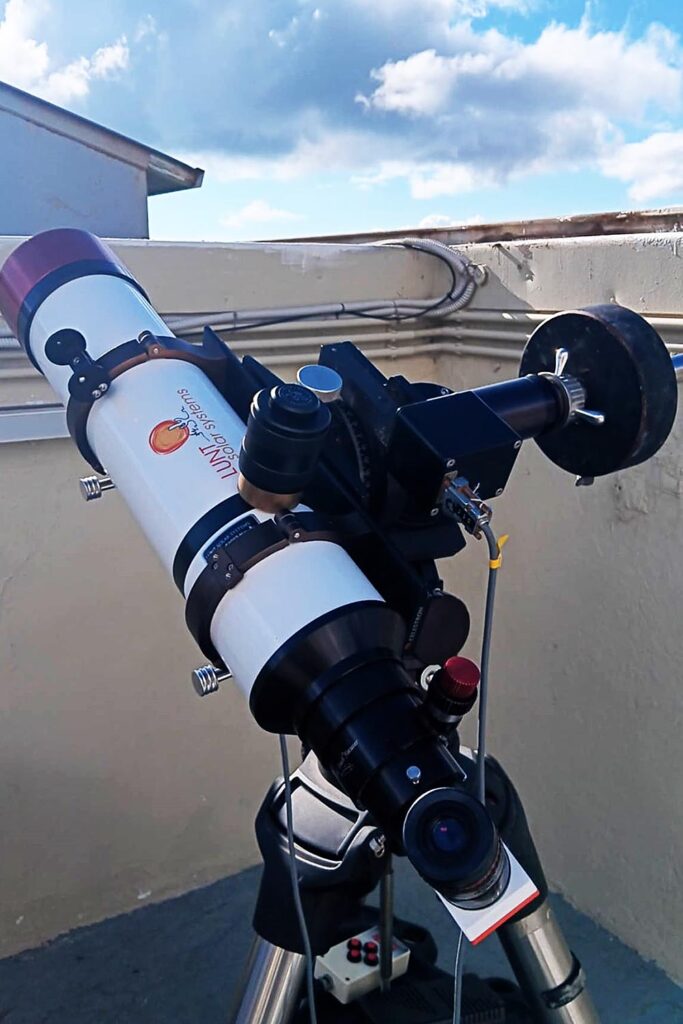
The LUNT LS100THa/B1800 Solar Telescope was purchased in 2018 by the Municipality of Corinth, on the initiative of Mayor Alexandros Pnevmatikos, to support safe Educational and outreach solar observing at the Stephanion Observatory.
The specialized solar telescope is designed for high-contrast viewing and imaging of the Sun’s chromosphere. Optimized for hydrogen-alpha (Hα) light, it reveals solar features invisible in white light, such as prominences, filaments, flares, and active regions.
The Observatory’s solar telescope comes as a complete observing setup with high-quality accessories:
– Losmandy Dovetail DC14-3″ – Provides a secure and versatile mounting interface compatible with a wide range of mounts.
– Baader Planetarium Hyperion Eyepieces – 13 mm for moderate magnification views
21 mm for wide-field, lower-magnification solar observing.
– LUNT LS7-21ZE Zoom Eyepiece (7.2 mm) – Offers flexible, high-magnification viewing to examine prominences, surface detail, and active regions in the chromosphere.
Above combination allows observers to switch easily between low- and high-magnification views, making it ideal for both casual visual observing and detailed study of solar phenomena.

FAQs
What Is a Cassegrain Reflector?
A Cassegrain reflector is a type of reflecting telescope that uses two mirrors to collect and focus light. Incoming light first strikes a large concave primary mirror at the back of the telescope, which reflects it toward a smaller convex secondary mirror near the front. The secondary mirror then reflects the light back through an opening in the centre of the primary mirror, where it reaches the telescope’s scientific instruments.
This folded optical path gives a Cassegrain telescope a long effective focal length within a relatively compact structure, making it particularly suitable for precise astronomical observations and for mounting scientific instruments such as photometers, spectrographs and cameras.
Although Stephanion Observatory’s 30-inch (76 cm) Cassegrain reflector has an effective focal length of approximately 10.3 metres, its tube is far shorter. By folding the optical path within the telescope, the Cassegrain design achieves a very long focal length without requiring an equally long telescope tube.